
If you do any kind of woodworking or furniture restoration, you already know the pain of sanding.
You spend hours trying to get into all the little nooks and crannies of a carved piece. The sandpaper clogs up in five minutes. Dust gets everywhere — in your lungs, on your tools, all over your shop. And if you’re working on an antique or a detailed carving, one wrong move with a power sander and you’ve ruined the detail forever.
So when people started talking about “laser sanding,” we started getting a lot of questions from our customers.
Is this something that replaces my orbital sander? Can I use it on furniture? Does it actually work?
Here’s the thing — laser sanding isn’t what most people think it is. It’s not a magic wand that replaces your sander. It does something different. And we’ve seen it in action enough times to know exactly where it shines and where it doesn’t.
So let me clear things up for you.
1. What is laser sander?
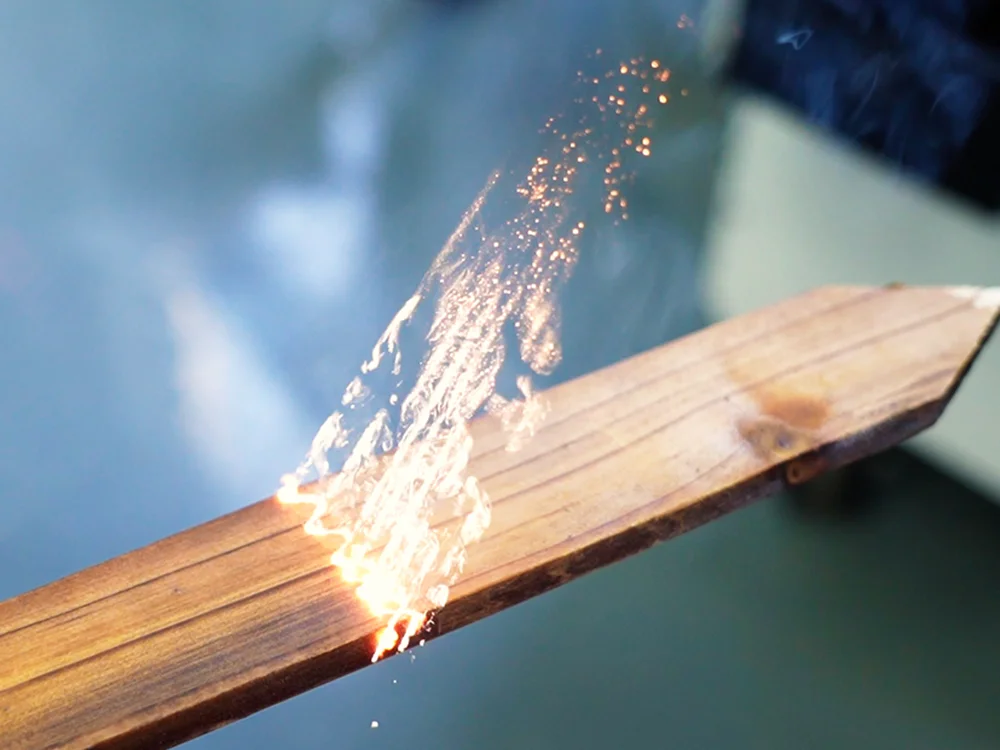
2. What does laser sander for wood actually do?

3. Laser sander for wood vs. Traditional sander for wood
What’s the difference between laser sander for wood and tradtional sander for wood? Here is a brief version:
| Traditional Sander for wood | Laser Sander for wood | |
|---|---|---|
| What it does | Physically scrapes material off with abrasives | Vaporizes coatings and contaminants with heat |
| Best for | Flattening, smoothing, removing material | Removing paint, rust, dirt; sanding shaped/detailed surfaces |
| Dust | Lots of dust, needs good collection | Almost no dust, but produces smoke |
| Consumables | Sandpaper, discs, belts | Protective lenses |
| Risk to detail | Can round over edges and destroy fine details | Leaves details intact, doesn’t touch the wood underneath |
4. Does laser sander for wood really work?
4.1. Real customer stories
Case 1: Wooden door refinishing — Germany (500W 15mJ Laser Sander)


Case 2: wood cabinet surface prep — Malta (500W 15mJ laser sander)


Case 3: White Kitchen Cabinet Refinishing — Italy (300W 5mJ Laser Sander)

More wood cases
If you want to learn more about real cases of laser paint stripping from wood, please click the following post:
4.2 What Science Says
Some researchers at Northeast Forestry University in China actually ran controlled experiments on laser sanding wood. They used two common woods — ash (a hardwood) and Korean pine (a softwood) — and hit them with a pulsed laser.
Here’s what they found:
-
It definitely works. The laser ablated the wood surface and removed material.
-
Softwood is faster. The pine (less dense) ablated at about 0.33 mm per second. The ash (denser) was slower at about 0.20 mm per second.
-
Frequency matters more than power. Cranking up the pulse repetition rate gave a bigger efficiency boost than just increasing the energy of each pulse.
Bottom line: The ablation speeds measured in the lab are enough to meet the practical requirements for sanding shaped wood furniture surfaces.
The full paper can be accessed at: https://ope.lightpublishing.cn/zh/article/doi/10.3788/OPE.20162413.0123/
5. Does laser sander work on metal?

More real customer cases of laser sanding on metal
You can find more before-and-after photos, videos, and customer feedback on different metal types and paint layers.