
Sheet metal cutting can be challenging with manual devices. Neither can you cut it fast nor meet the required accuracy. To make the process more productive, people have developed various ways of cutting sheet metal. Each of these ways has unique benefits and limitations.
If you are looking for precision cutting, laser cutting offers you accuracy up to ±0.01mm. Waterjet cutting provides accuracy of up to ±0.255mm, while plasma cutting provides accuracy of ±0.55mm. If you are considering a more affordable solution, oxy-fuel or mechanical cutting may be a better option. If you are aiming to cut thick metals, plasma cutting can offer you a faster cutting process.
So, each method has its unique purposes. That’s what we are going to talk about in this article. We will go through each technique, its working process, and applications. Besides, we will specifically learn more about their pros and cons.
Popular Sheet Metal Cutting Methods in Industrial Applications
In the metal fabrication industry, five sheet metal cutting methods are widely popular. They are laser, waterjet, plasma, oxy-fuel, and mechanical cutting. Each of these methods differs by its working principle, applications, and type of products it makes.
Laser Cutting
The laser cutting method is an industrial process that uses a high-energy laser beam to cut metals. As you know, it’s a non-contact method, ensuring a safe and high-precision outcome from each cutting. You may also consider it a sheet metal cutting tool.
How to cut sheet metal via the laser cutting method? It can be highly automated for precise cutting. In the cutting process, the machine creates a coherent beam of light from the laser source and directs it to the material spot.
The laser source typically creates the laser beam and sends it to the optics. Optics, on the other hand, manipulate this laser beam to focus on the target spot. Later, with the help of CNC machining, the laser gun moves along the designed path. Once the laser beam hits the surface, it continues to heat the area until it melts, vaporizes, or burns away.
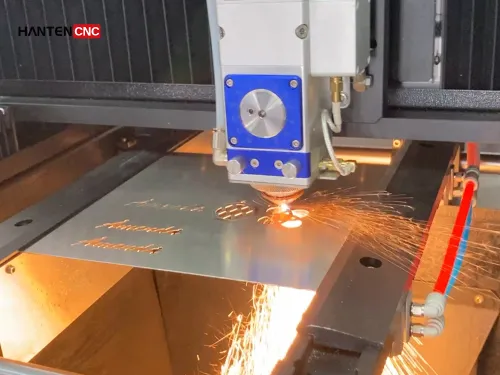
During the process, you might want to use some auxiliary gases to remove the melted metals. In most cases, oxygen, nitrogen, and others can be used. This way, you can ensure high-quality and clean edges at the cutting spot.
In industrial applications, the laser cutting method is typically used to cut materials ranging from 0.1mm to 25mm thick. It is widely popular in various industries. You can think of any sector that involves metal fabrication.
Pros
- Exact and accurate with intricate design at lower tolerances
- Cutting-edge quality is excellent
- Versatile method with minimal material waste
Cons
- The initial cost is high.
- No specific advantage for linear cutting
- Generally not suitable for reflective metals
Waterjet Cutting
The water jet cutting process uses a high-pressure stream of water to cut through the metal. The use of water allows the process to cool down quickly. Since it does not use any thermal elements, there is no chance of thermal stress, as it is cool.
A water jet pressurizes the water to extremely high levels (40,000 psi to 60,000 psi) and flows it through a nozzle. The nozzle is so small that it produces a focused and mighty stream with ease. Typically, it can reach speeds that are 2 or 3 times that of air. With this speed, it can easily cut almost all types of material.

You may use it for various purposes, including cutting marble, steel, aluminum, titanium, or other alloys. You can easily cut thick materials (0.1mm to 150mm) using the waterjet method. Mostly, it serves industrial work.
Pros
- Can be used for cutting versatile materials
- No Heat Affected Zone (HAZ)
- The entire process is eco-friendly for using water
Cons
- This method is not suitable for cutting thin or delicate materials. The pressure is high, which can easily cause damage to the materials.
- The setup is complex and needs bigger spaces. You must also have a proper ventilation system. It adds to the final cost.
Plasma Cutting
Plasma cutting is a thermal cutting process that utilizes an ionized gas, also known as plasma. Here, a high-speed jet flows plasma to melt the metal and cut electrically conductive materials. It can cut metal thickness ranging from 3 to 50+ mm easily.
The process begins by creating an electric arc inside the electrode and the torch. Then, compressed gas, such as oxygen or nitrogen, is forced to flow through the nozzle. The arc then ionized these gases, converting them into a plasma state, which is the fourth state of matter. The temperature of the plasma state is around 40,000°F (22,200°C), which easily melts the underlying material, creating a clean cut.
The plasma cutting method is used in the shipbuilding and construction sectors. Also, it offers a cutting variety of conductive metals, including stainless steel, brass, and automotive parts. There are cnc plasma cutters that can cut detailed designs with accuracy and precision. It can often be portable for on-site work due to the flexibility of instant part replacement.
Pros
- The initial cost is relatively lower than that of plasma and waterjet cutting.
- Plasma cutting is faster than 0xy-fuet cutting
- Reduce the post-processing work with minimal slag
Cons
- This method is not suitable for cutting thin metals. There is a huge risk of warping or material damage.
- Edge quality is good, but may have dross
- The process is noisy and can generate hazardous fumes
- The intense heat can also produce HAZ around the cutting
Oxy-fuel Cutting
Oxy-fuel cutting, also known as flame cutting, utilizes chemical reactions to cut metals. It is also a popular type of thermal cutting process, like plasma cutting. This cutting method is one of the oldest, simplest, and most widely used processes in the world.
Oxy-fuel cutting comes along with two steps: 1. preheating, and 2. cutting. In the primary stage, or first step, a torch uses a mixture of oxygen and a fuel gas, such as acetylene or propane. Thereafter, it creates a flame to heat the metal to reach its ignition temperature. When the metal is heated, a high-pressure jet releases oxygen from the torch to burn the surface, resulting in a clean cut.
The oxy-fuel cutting method is used for carbon steel and low-alloy steel. It is also a popular choice for demolition and scrap yard operations. The cutting thickness ranges from 1mm to 1.2 mm.
Pros
- Suitable for cutting thick materials
- The initial investment cost is relatively lower than that of other methods.
Cons
- The entire process is very slow
- Contains a large heat-affected zone (HAZ)
- Requires strict safety protocols during cutting
- Limited to a few metals containing iron
Mechanical Cutting
The mechanical cutting process typically depends on physical force to shear or cut the materials. It does not use heat sources for cutting. In this process, the main types are shearing and punching. Shearing uses two blades and resembles scissors to ensure a straight cut. On the other hand, punching requires a punch and a die to create a hole in the materials. Apart from this, there are other mechanical cutting techniques, such as sawing, milling, and drilling.
Mechanical cutting methods are widely used in metalworking shops. You may also create custom products, prototypes, and cut intricate designs easily. Applications demanding accurate cuts and flawless finishing benefit from these technologies.
Pros
- Suitable for mass production due to high speed and consistent repeatability
- Tooling and machinery are less expensive compared to thermal processes
- Easily handle versatile materials with different thicknesses
Cons
- While machines are cheaper, punching dies are expensive and time-consuming.
- Punching may leave a significant amount of material.
- Cutting edges can sometimes have burrs and rough finishes.
How to Cut Sheet Metal with a Laser Cutting Machine
To cut metal sheets with a laser cutting machine, you have to go through some key steps. These steps will guide you to achieve the best outcome without making any mistakes. It will be easier for beginners to laser cut metal sheets by following the step-by-step guides. Let’s go for it.
Choose the Right Sheet Metal Laser Cutting Machine
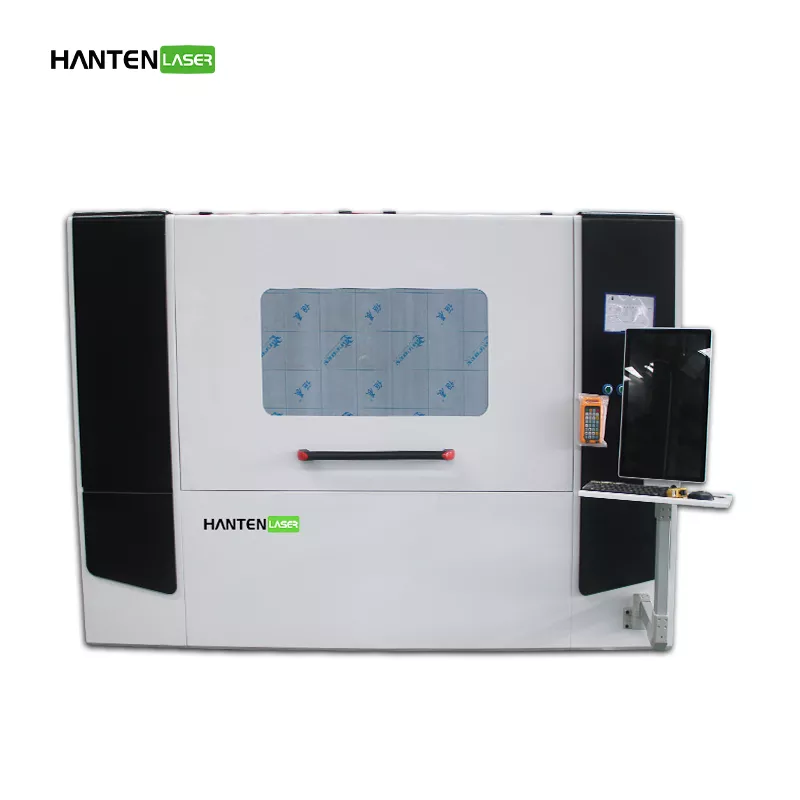
The first step is to choose the right machine according to the needs. Here is our top-tier product, a 1000W-6000W enclosed CNC fiber laser cutting machine for metal sheets.
It contains a wide range of capabilities, like automated, refined, and fast cutting. The price segments range from $15,350 to $23,680. These prices vary according to efficiencies such as power, speed, accuracy, and penetration levels. Therefore, choose everything accordingly to achieve the best results.
Prepare the Workspace & Safety Gears
Before you begin the process, make sure the workspace is clean. Set up the ventilation system correctly and wear safety goggles or a helmet. Don’t forget to wear heat-resistant clothes. Then proceed to the next step.
Insert the CAD file into the Machine & Configure the Machine
Convert your design into a DXF or DWG file to make it readable for machines. Then, import the file into the machine’s software. Set up all the parameters (power, speed, depth, focus) accordingly and start the process.
Observe the Cutting Process
Once the machine starts, observe the entire process until it concludes. Observing the process is essential to avoid errors and take necessary precautions in the event of a technical failure. It allows you to turn off the machine in case of an emergency.
Post Process If Necessary
After cutting, remove the material from the board. Inspect the cuttings and edges for any burn marks or rough spots. If there are such spots, use post-processing methods, such as sanding or deburring, to make the edges sharp and smooth.
Summary
Choosing the correct sheet metal cutting method is not tricky. You know what you want for your project. This article just helps you to learn more about the other choices. If you require precision cutting and intricate designs, laser cutting is the ideal choice. It is ideal for most general-purpose works.
However, if you need to cut thicker metals exceeding 25mm, you may need to consider alternative cutting methods. Each of these methods has its unique advantages and limitations.