
A laser welding machine is widely used across various regions. Nowadays, it is widely used to make many modern parts and components. The aerospace, automotive, electronics, and medical sectors widely use it. When you are considering switching to laser, understanding the laser welding machine components is necessary.
A laser welding machine works on both thin and thick materials. It is an advanced manufacturing tool for joining metals with greater accuracy and speed. Compared to other technologies, it offers lower heat input & distortion and excellent repeatability. It’s a reliable solution for both workshops and industry users.
This article provides a clear insight into the laser welding machine components and how they work. Knowing the function and role of these parts helps you better understand the machine.
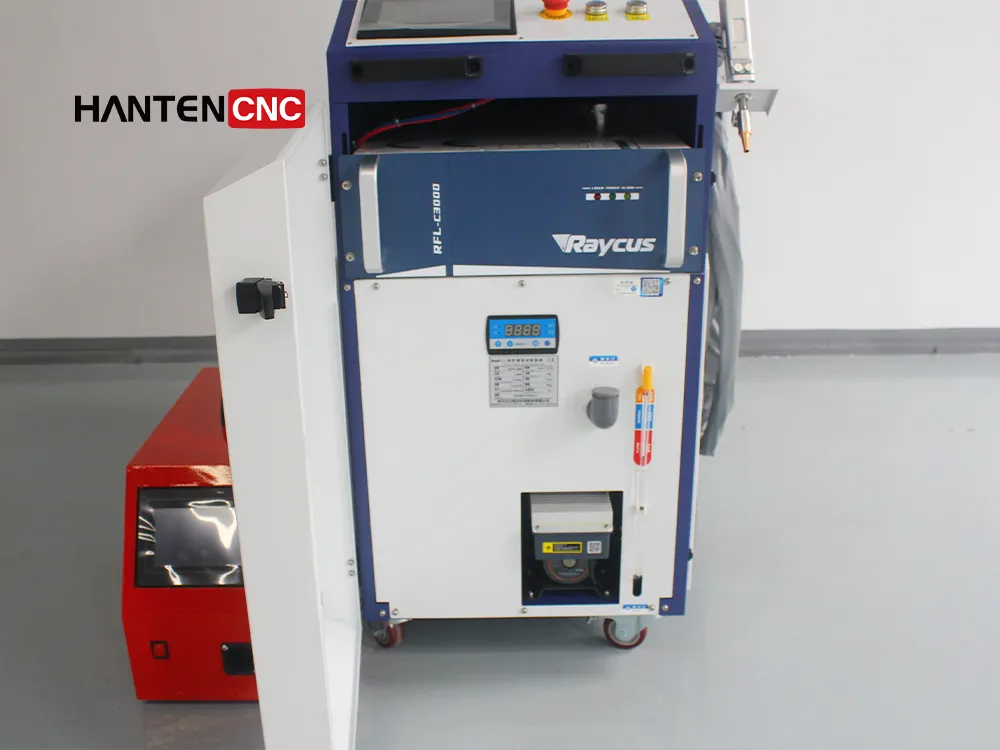
Laser Welding Machine Components
Laser welding machine components work together to complete laser welding. Starting from the laser source to the welding torch, each component plays a crucial role. When you choose laser welding, you must ensure each of these parts is high-quality and reliable. Even a single substandard component can compromise the entire system.
1. Laser Source or Laser Generator
The laser source is the most critical part of the laser welding machine components. It generates the laser beam essential for laser welding. Modern-day machines typically use one of four laser sources. These are fiber laser, CO2 laser, Nd: YAG Laser, and Diode Laser. Each laser source works differently, varying based on materials and penetration levels, depending on power. They contain particular advantages.
Fiber and Nd-YAG lasers are the most common for laser welding projects. Some traditional laser welders may come with Co2 and diode lasers.
Fiber Laser
A fiber laser welding system uses a rare-earth metal as an active medium with an optical fiber source. This system is a modern industry standard due to its high beam quality and electrical efficiency. The wavelength it emits is relatively short or narrow, making it readily absorbed by almost all materials. Particularly, the system is ideal for reflective metals. You can easily weld aluminum, brass, and copper.
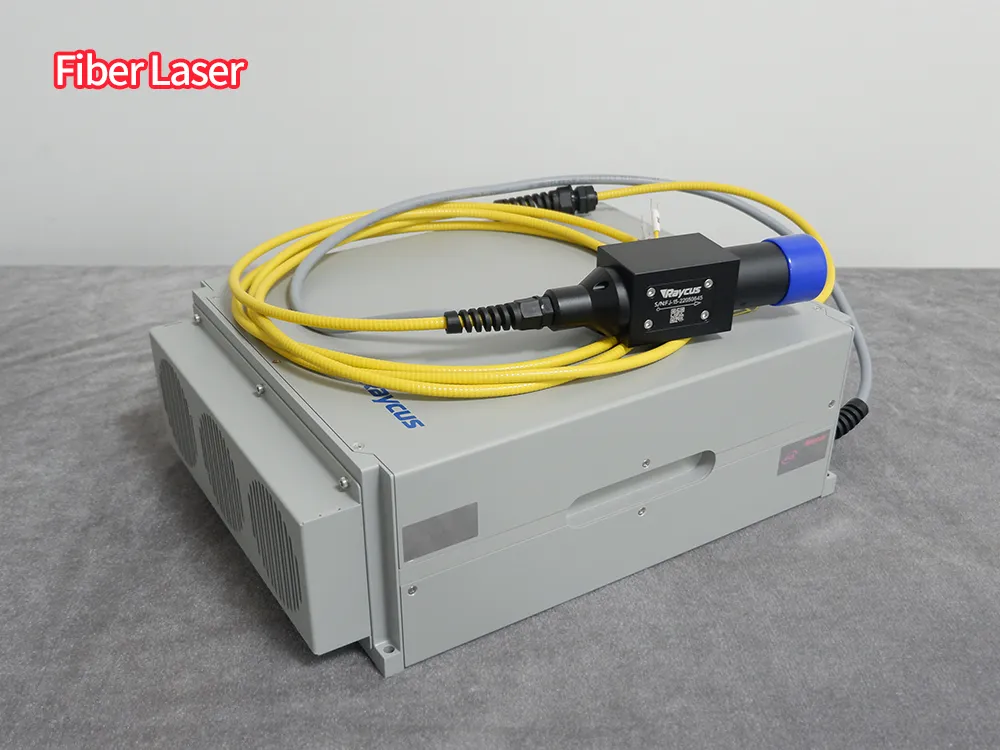
CO2 Laser
A CO2 laser uses a gas mixture, such as carbon dioxide, nitrogen, and helium, as its active medium. This source emits a light beam with a wavelength of almost 10.6 micrometers (µm). It is wider than the fiber laser wavelength, which is poorly absorbed by shiny metals. However, it works very well with organic materials, such as wood, plastic, and glass.
Nd-YAG Laser
The Nd: YAG laser (Neodymium-doped Yttrium Aluminum Garnet) is a solid-state laser that uses a crystal rod. This laser source is typically preferred for pulse laser welding.
The source emits a short burst of energy, enabling it to deliver a small average heat output. This approach prevents materials from warping or melting. As a result, the Nd-YAG laser welding system is a suitable option for micro-welding, such as jewelry, and for assembling sensitive electronics.
Diode Laser
A diode laser is typically a semiconductor device that converts electrical energy directly into light. Though it’s a semiconductor device, it produces a much more powerful light beam. When an electric current passes through the diode, photons are emitted and amplified.
Compared to a fiber laser, it creates larger, less intense welding spots on the material. Its frequent applications are plastic joining, automotive roofs, and hardening surfaces.
2. Beam Delivery System
The beam delivery is responsible for carrying the produced laser beam. Throughout the journey, the laser beam is further amplified based on the project’s needs. It is one of the most crucial components of a laser welding system.
Experts say a laser source alone cannot ensure perfect beam quality. It also heavily depends on how it is carried to the welding torch. However, the beam delivery system involves several key stages.
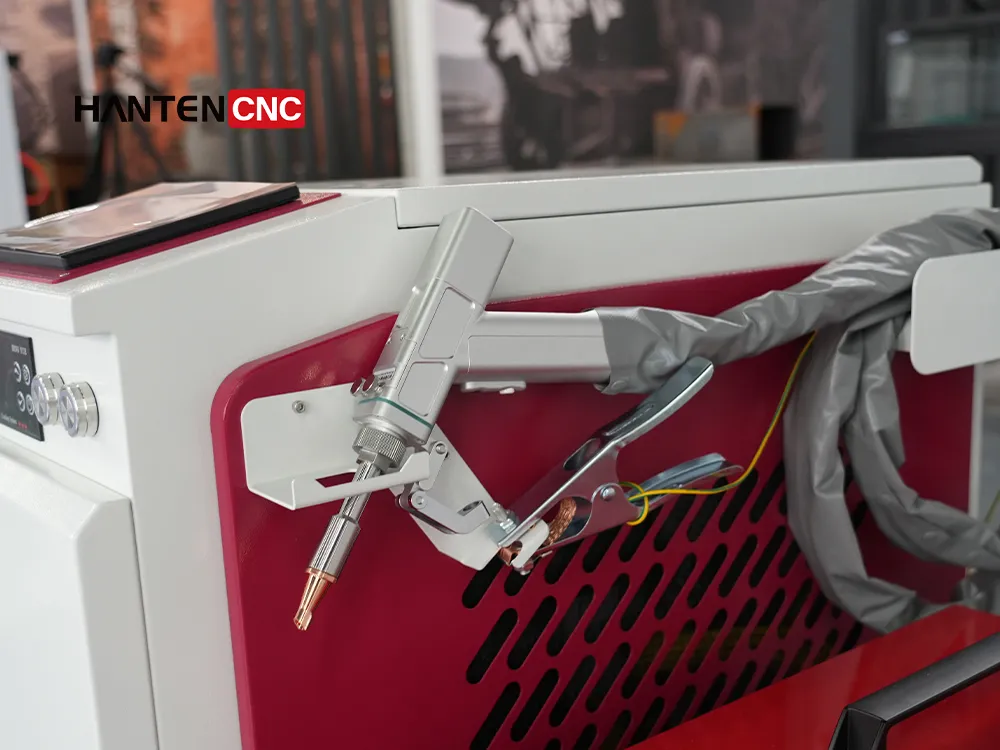
Step #1 Fiber Optic Cable
The fiber-optic cable is an optical light pipe that carries the light beam to the laser head. Before it reaches the welding head, it uses high-purity glass, minimizing energy loss. Additionally, the cable stabilizes the light beam and prevents distortion. This flexibility ensures consistent energy delivery suitable for precise, high-speed welding.
Step #2 Collimating Lens
A collimating lens is also a vital laser welding machine part. The lens captures the diverging light beam and converts it into a parallel beam. This parallel light beam makes the rest process easier. If the lens does not capture it, the welding gun can easily overheat and damage the machine wall.
Step #3 Wobble System
The wobble system uses a mirror setup that moves according to the design. These designs could be circular, zigzag, and many others. This technique “stirs” the molten metal pool. This way, it helps bridge wider gaps between two metals and makes joints stronger and smoother. Air gaps also remain lower due to the wobbles system.
Step #4 Focusing Lens and Shield
The focusing lens converges the light and focuses it to a very small spot. Thus, it heats the surface, causing the metal to melt. Below the lens, there is a glass covering called the shield. This protective shield covers the expensive optics from spatter, sparks, or fumes. It’s one of the most frequently replaced parts on a laser welder during routine maintenance.
3. Welding Head
The welding head is the “business end” of the machine. After the laser is amplified and travels across the delivery system, it finally reaches the welding head. You can either hold it with your hand or attach it to a robot or CNC-controlled device.
The handheld laser welding machine components are seen for most general-purpose works. However, for industrial uses, automated systems are more common.
The welding head or torch has an adjustable nozzle that allows the creation of various welding shapes. Additionally, shielding gas pipes may be added to improve welding quality.

4. Wire Feeder
The wire feeding machine is typically an external device. It automatically pushes the filler metal into the welding area. As the device motorizes, the filler wire/metal is fed at a constant speed. It allows the laser welding system melt the base metal and filler wire simultaneously. It bridges any gaps or “valleys” in the weld joints.
This machine is generally used when a large gap needs to be bridged or when a smooth fusion is required. Mostly, people use them to fuse two dissimilar metals or metal sheets. Using these external feeders makes the joint much stronger and enhances the seam’s visual appeal. It also prevents “undercutting,” where the laser melts too much material.

When to Use Filler Wire?
- Use a wire feeder when the gap is 0.5 mm to 2.5 mm.
- To increase strength, add metal volume.
- Apply it to alter the chemistry and prevent cracks.
- Employ a wire feeder for better surface finishing.
4. Control System
The control system manages all the electrical signals in a laser welding system. It allows the system to specify all the parameters to run it smoothly. These parameters are power wattage, laser energy, pulse frequency, and wobble pattern. Using precise level energy and power ensures consistent melting without burning through or damaging it. Also, the laser prevents weak spots in the weld.
Besides, the system serves as a safety monitor throughout the entire operation. Every time, it checks for defects and flaws. The system also inspects for a lack of shielding gas or overheating of the laser head. If any problem is identified, the machine shuts down by itself. Thus, it protects valuable machine parts and base materials.

5. Cooling System
The cooling system is another vital component of a laser welding system. Typically, it is the “life support” of a laser welder. As you know, the laser source produces intense heat that can cause optics or laser heads to overheat. Overheating may cause the device to shut down or result in severe damage. To avoid this damage, a proper cooling system is a must.

Type #1 Water Cooling System
A water-cooling system uses a dedicated chiller to circulate water through the source and the laser head. This system includes a compressor and a pump to stabilize the machine’s internal temperature. Thus, it removes heat very quickly and effectively. As a result, people find it useful for heavy-duty or high-power machines (1500W to 3000W).
Type #2 Air Cooling System
This system utilizes fans and copper sinks to dissipate heat into the surrounding environment. These elements are lightweight and eliminate the need for water pumps and compressors. The system is simple and less costly. Most manufacturers prefer it for ultra-portable, lower-power handheld laser welders (up to 1500W).
Summary
A laser welding machine is a complex system composed of five primary subsystems working in harmony. Each system has a specific function based on its usage. It begins with a laser source that generates light and a beam delivery system that transfers it through an optical pipe. The welding head then directs it upon the material as designed. Often, the system may use a wire feeder machine to bridge gaps and strengthen the joint.
To keep the entire process safe and precise, a control system works as the brain. It manages power, speed, and more. Lastly, a cooling system maintains a stable temperature. The cooling system can be of two types, as mentioned, 1. Water cooler and 2. Air cooler. Based on your machine types, manufacturers design laser welders with cooling systems.
HantenCNC is a leading manufacturer of a wide range of laser welding machines. In addition to the standard specifications, we also offer custom design and setup. Based on your needs, our professionals can help you reach your goal. Feel free to reach out to us with any queries or suggestions.