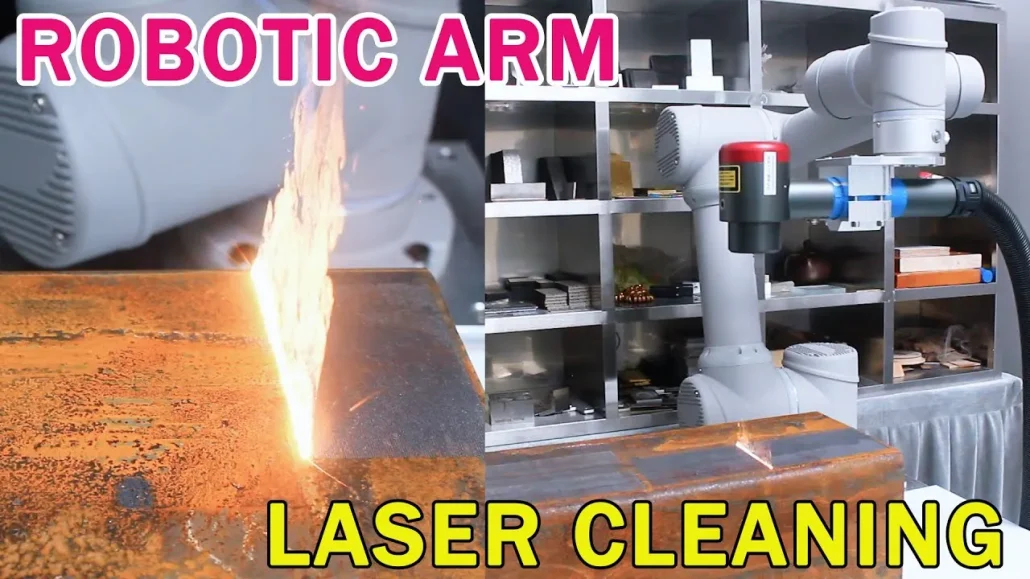
Laser cleaning machines are widely recognized and used across various industries. From cleaning rust and paint to preparing surfaces, they have a wide range of applications. In this context, handheld laser cleaning machines are very popular. But the need for productivity and effective cleaning is growing as we progress daily. To overcome this, the demand for the robot laser cleaning machine is rising. It has made a level-up contribution to revolutionizing industrial cleaning methods.
Manufacturers are improving their design and efficiency to fulfill customer needs. You can use it for different industrial cleaning purposes. For elaborate details about robot laser cleaning machines, read on.
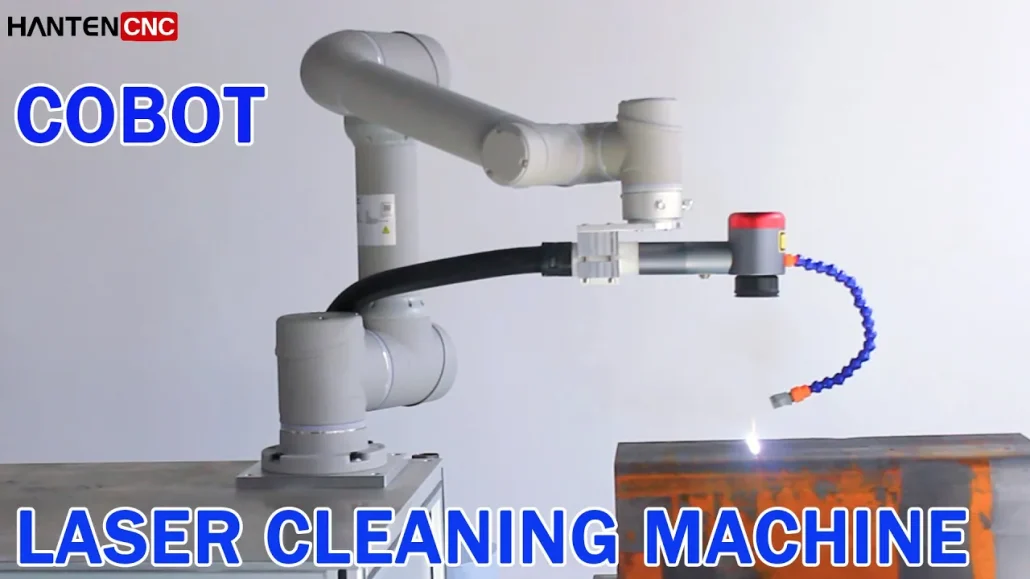
Overview of Collaborative Robots in Industrial Applications
Collaborative robots are also known as cobots. It is one of the newest technologies in the industrial sector. Cobots can do work faster and more efficiently.
Since it is fully controlled, you can use this device for various tasks. In addition to laser cleaning, it can also be used for welding, assembly, and inspection.
These robots are easy to program and can shift to different work with the same precision. Also, cobots are smaller and safer than traditional techniques.
Most automated manufacturing utilizes cobots for faster and more accurate work. It is prevalent mainly in electronics, automotive, medical, and metal industries.
By utilizing this technology, you can improve the speed and quality of your work. Additionally, you can also reduce stress at work and make it easier and safer. You can also reduce labor costs, save time, and, of course, boost your entire production.
How to Use Collaborative Robots in a Smart Cleaning System
There are several steps when using a cobot pulse laser cleaner. These steps are essential to get optimal results when cleaning. We will describe it in the following sections. Read it carefully and apply it to experience a better outcome.
Stable Set Up & Installation Guide
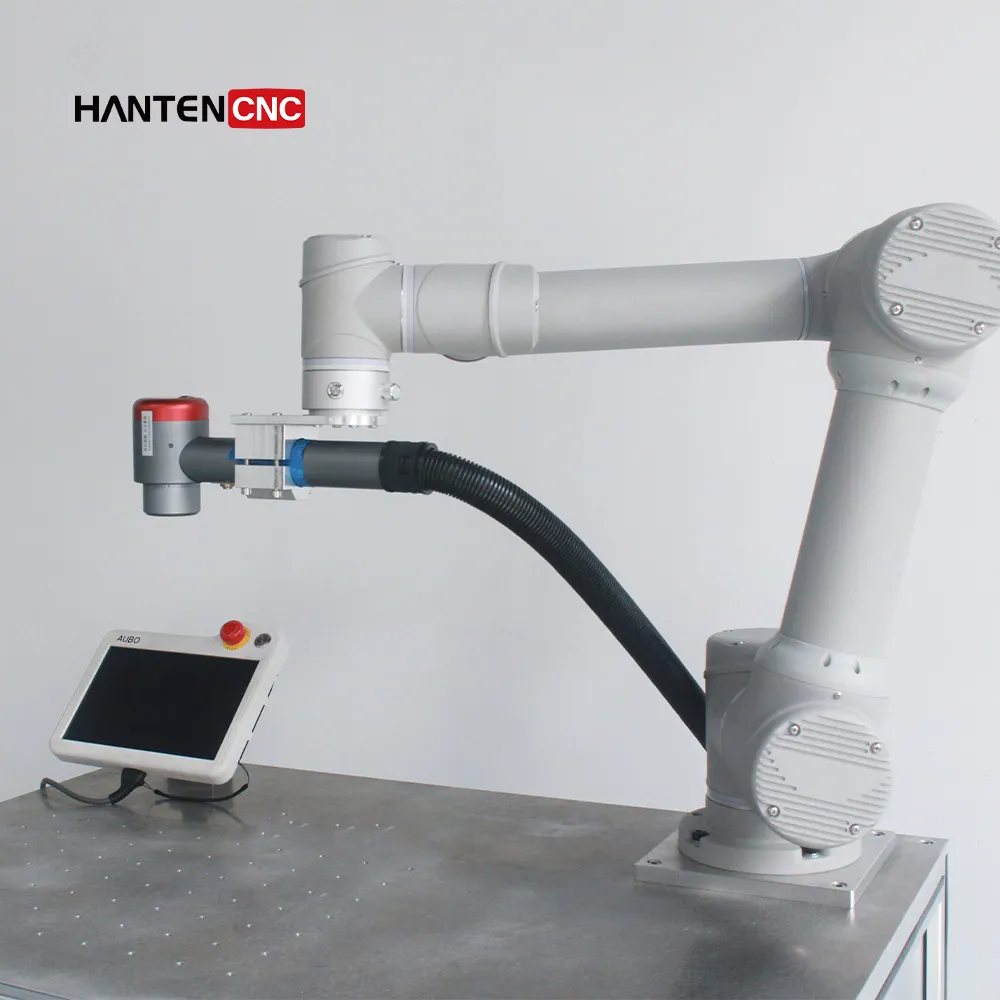
To start the process, place the robot base at the chosen work location. Next, use a machining tool to mount the laser cleaning head onto the robot flange accurately. Set the load and adjust the center of gravity. Make a proper plan and arrange cables, fibers, or cooling pipes between the laser source and the cleaning head. Lastly, connect the I/O cable to enable communication and control.
Smart Path Planning & Laser Parameters
To make a smart path plan, use the robot’s teach pendant. Set the distance of the cleaning head based on the focus lens. Make sure the laser stays a suitable distance away from the surface. And the most important part, according to your cleaning goal, is to set power, pulse width, frequency, and scan pattern. This will help you to remove rust, paint, oil, or a wide range of dirt.
Start & Stop with DO Signals
Use digital output (DO) signals to conduct the process. Set DO signals high to start the cleaning at the initial point. On the other hand, set it to low signals to stop at the end location. Here, you can set a delay of 0.0 seconds after starting. It will ensure that the beam covers the total area with complete and smooth operation.
Safety with Collision Protection
Take full advantage of the force sensor function of cobots. It can protect both the cleaning head and the workpiece. Properly set the collision sensitivity to detect any kind of impact. These settings will stop the cobots and prevent damage to the tools and surface.
Test & Optimized Settings
Before starting, test the settings on a small area of the workpiece. Observe the cleaning effect with visual inspection tools. Ensure that the parameters are suitable for cleaning. Evaluate speed, power, frequency, and pulse width with the testing result. If the setting is perfect, then start the procedure. Our goal is to ensure safe cleaning without any damage.
Advanced Programming
You can teach the robot path manually using the drag-to-teach method. Also, you may edit the path and the trajectory. For complex tasks, you can use third-party software with CCD or 3D tools to edit the path. This makes your cleaning task easier and more flexible for a wide range of cleaning tasks.
Technical Advantages of Using Cobot Laser Cleaning Machines
Using this pulse laser cleaning machine has a lot of benefits. It can provide technical benefits to high-precision work. The DO signal, sensor, and camera guide the laser head to move to the exact area.
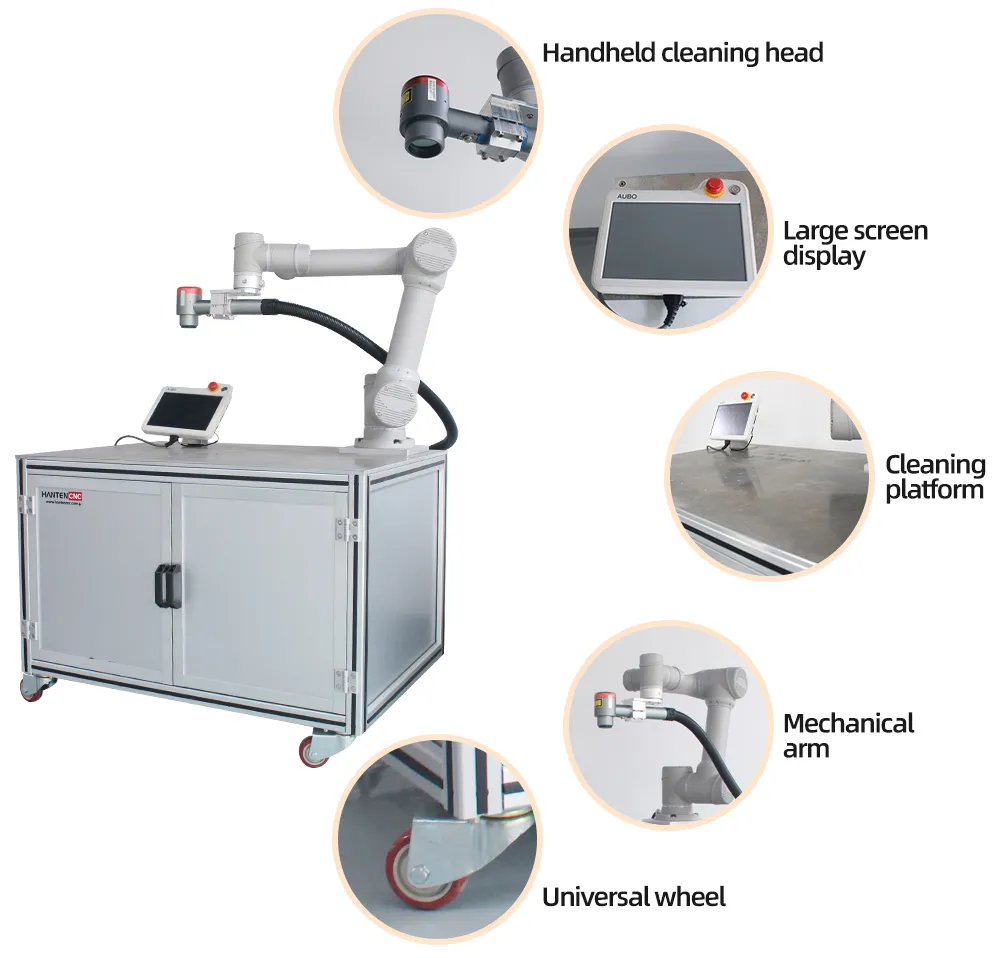
The robot controller can provide an output voltage for the laser cleaning head to work. Besides, it can control the start/stop function for laser emission. This feature is controlled through digital I/O signals. There is no complex control system. The entire process is quite easy and simple to operate.
You can also maintain a stable distance from the surface and lead the laser. Thus, the laser rust removal machine can remove rust, oil, paint, or dirt without harming the base material. It does not even decrease the material properties. Its purpose is to ensure high-quality cleaning jobs.
Overall, you can customize everything to your liking to achieve optimal results. Even in complex designs, you will be able to give proper, clean, and finishing touches.
Popular Industrial Use Cases
This machine can serve a wide range of cleaning purposes. Usually, manufacturers prefer it for high productivity. Additionally, its accuracy and ability to handle complex designs also make it a popular choice in many applications.
Cleaning Complex and Irregular Surfaces
When cleaning stepped materials, we often encounter lasers positioned at different heights. We may do the same for irregular arc surfaces and other special-shaped materials for cleaning. Examples are aircraft, automotive, electronic, and other surfaces. To clean them, we recommend using a robot laser cleaning machine for better results.
Rust Removal
One of the most popular uses of cobots is the removal of rust or oxide layers. Most of the time, this specific work is done before or after the primary production of metal parts.
Popular cases include metal surface preparation before painting or after metal casting. The accurate cleaning of rust typically improves the adhesion of coatings. This way, you can extend the lifespan of metal parts and their coverings.
Paint and Coating Stripping
Another use case of the robot laser cleaning machine is painting, coating, and stripping. It is a popular use case for repainting. You may often find its use in the aerospace, automotive, and electronic sectors.
Oil and Residual Removal
Similar to a regular laser cleaning machine, robot cleaners also help in removing grease, oil, or production residues. The key difference between those two laser cleaners is the use of automated or AI integration.
HantenCNC Integrated Technical Solution for Laser Cleaning
HantenCNC offers a complete technical solution for cleaning machines and robots. The laser cleaning head is lightweight and easy to connect to the robot. We set up the cable/air pipe/optical cable in such a way that it easily meets the end load requirements. At the same time, we ensure that the tools and interface of the cleaning head are compatible with the end flange of the robots.
Conclusion
Let’s wrap everything up! This article provided a comprehensive overview of robots in conjunction with a laser machine. You have gone through what it is, how it works, and what its popular use cases are.
It also explains the fundamental differences between a regular and a robot laser cleaning machine. HantenCNC is a leading manufacturer of various laser machines. Feel free to ask us anything.