Laser cleaning is an advanced, non-contact, and eco-friendly method for removing rust, paint, oil, oxide layers, and other contaminants from a wide variety of materials. Unlike traditional cleaning methods that rely on chemicals or abrasives, laser cleaning uses a focused beam of light to precisely remove unwanted layers while leaving the base material completely intact.
This article explains how laser cleaning works, the key technical parameters involved, and why it is becoming the preferred industrial cleaning solution worldwide.

2. The Origins of Laser Cleaning
The concept of laser cleaning dates back to 1965, when Schawlow first demonstrated a groundbreaking experiment using a pulsed laser to remove ink from paper without damaging the paper itself.

In the 1980s, IBM began exploring laser technology for semiconductor mask cleaning, and in 1987, researchers W. Zapka and colleagues filed the first patent for laser cleaning in semiconductor manufacturing.

From these early scientific milestones, laser cleaning has evolved into a mature industrial technology applied in aerospace, automotive, electronics, and heavy machinery industries.
3. Limitations of Traditional Cleaning Methods
Traditional cleaning methods such as mechanical grinding, sandblasting, and ultrasonic cleaning all have significant limitations:
-
Mechanical cleaning often damages the material surface and generates secondary waste.
-
Ultrasonic cleaning, while effective for some applications, struggles to remove submicron particles because cavitation bubbles are much larger than the contaminants. It also has difficulty cleaning blind holes or complex geometries and is not suitable for large workpieces.
Laser cleaning overcomes these drawbacks. It is precise, damage-free, chemical-free, and highly adaptable—ideal for both small components and large industrial structures.

4. The Core Principle of Laser Cleaning
Laser cleaning works by directing a high-energy laser beam onto the contaminated surface. When the contamination absorbs the laser energy, it either vaporizes instantly or expands due to rapid heating. Because the contaminant and substrate have different thermal expansion coefficients, the contaminant detaches from the base material.

Different laser wavelengths are used depending on the material and type of contamination:
-
355 nm (UV lasers) – high absorption rate for copper and delicate materials.
-
1064–1080 nm (fiber lasers) – suitable for most metals and oxides.
-
10640 nm (CO₂ lasers) – ideal for non-metallic materials such as rubber or coatings.
For example, when cleaning the rubber insulation on copper wires in new energy vehicles, we generally use a 10640nm wavelength laser. We can also use a 1064nm laser. During cleaning, the oxide layer of the copper can be cleaned at the same time to achieve the purpose of non-destructive cleaning.

5. Key Technical Parameters of Laser Cleaning
Laser cleaning performance is determined by several key parameters, especially for MOPA fiber laser systems:
- Pulse Width (τ) – The duration of a single laser pulse, measured in nanoseconds (ns), picoseconds (ps), or femtoseconds (fs). Shorter pulse widths deliver higher precision and less heat damage.
-
Frequency – The number of laser pulses per second (Hz). Higher frequencies mean more laser shots and faster cleaning speed.

3. Peak Power (Pₚₑₐₖ) – The maximum instantaneous power output during a pulse, determining the ability to remove stubborn contaminants.
4. Single Pulse Energy (E) – The total energy released in one pulse, calculated as:
E = Pₚₑₐₖ × τ
A shorter pulse width increases peak power, allowing efficient removal of tough oxide layers or rust while minimizing substrate damage. This balance of pulse width, frequency, and power is what makes fiber laser cleaning machines so versatile for precision applications—from microelectronics to ship propellers.
6. From Cleaning to Surface Texturing
In some cases, controlled laser cleaning is used intentionally to roughen a surface—a process known as laser texturing or laser roughening.
Instead of merely removing contaminants, the goal is to increase surface roughness to improve coating adhesion.
For instance, laser cleaning can prepare aluminum shells of lithium battery packs or aircraft skins for painting.
High-power pulsed fiber lasers with peak power up to 10 kW can modify surface roughness by 10–30 μm in a single pass, providing optimal conditions for subsequent coating or bonding processes.
7. Types of Laser Cleaning Machines
HANTENCNC offers two main types of laser cleaning machines — pulse laser cleaning machines and continuous laser cleaning machines — each designed for different industrial needs.
-
Pulse Laser Cleaning Machines
Pulse fiber lasers emit short, high-energy bursts of light that can precisely remove rust, oxides, oil, and paint without damaging the base material.
They are ideal for applications requiring fine control, such as precision components, molds, and surfaces that demand non-destructive cleaning.
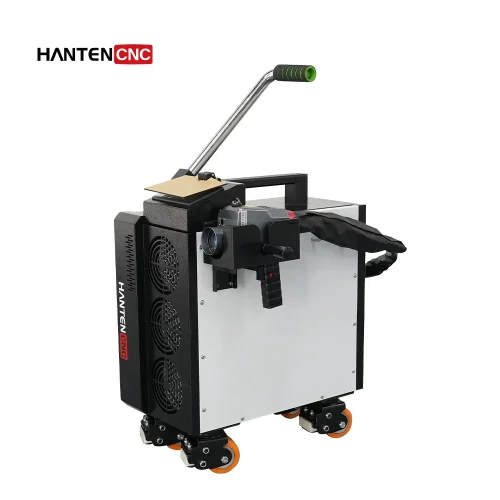

- Continuous Laser Cleaning Machines
Continuous-wave (CW) lasers deliver constant, high-power output, making them perfect for removing thick rust, paint, or oxide layers over large areas.
These machines are widely used in shipbuilding, heavy equipment maintenance, and large-scale industrial production where cleaning speed and efficiency are critical.
Both types of HANTENCNC laser cleaning machines feature adjustable power settings, making them adaptable to different materials and surface conditions.
Conclusion
Laser cleaning represents the next generation of industrial surface treatment—offering precision, efficiency, environmental sustainability, and versatility.
From delicate semiconductor components to large ship structures, it delivers superior cleaning results without damaging the base material.
Discover HANTENCNC’s full range of fiber laser cleaning machines and explore how non-contact laser cleaning can revolutionize your industrial surface treatment process.