
Laser cleaning generally falls into two categories: continuous and pulse cleaning. Continuous laser cleaning will definitely damage the metal surface, usually by tens of micrometers; pulse cleaning can control the degree of damage, limiting it to a few micrometers.
How Laser Cleaning Works?
The core principle of laser cleaning is selective absorption.
Lasers used for industrial cleaning usually operate in the 1064–1080 nm wavelength range. Different materials absorb this wavelength at very different rates.
Materials with high absorption rates, such as rust, oil stains, and paint, will rapidly heat up, expand, and vaporize within a very short time. When irradiated by a laser, these materials instantly absorb a large amount of energy, leading to rapid temperature increases that cause expansion, vaporization, ionization, or detachment from the substrate.
Meanwhile, the base material has a low absorption rate and heats up slowly, such as steel, aluminum, and copper. Therefore, during the extremely short duration of a laser pulse—such as on the nanosecond scale—energy is primarily absorbed and removed by the contaminants on the surface, while the temperature rise of the base material remains minimal, thus protecting it.
If Laser Cleaning Damage Metal, Can It Be Used on Molds?
Yes, laser cleaning can be used on metal molds, but it must be used correctly on molds. but two key points should be considered:
1. Molds are commonly made of steel or aluminum. For these materials, it’s best to use a pulsed flat-top laser beam rather than a Gaussian beam. The flat-top beam delivers higher energy per pulse, heating contaminants very quickly.
With high single-pulse energy and very short interaction time, contaminants can be heated and removed quickly, while minimizing heat penetration into the metal substrate. This helps reduce the risk of surface damage to the mold.
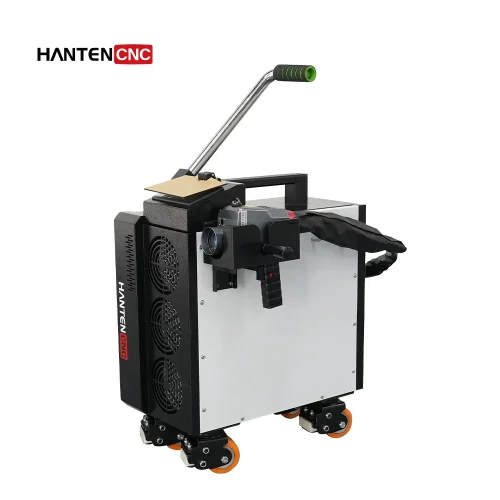
2. Compared with handheld laser cleaning, automated laser cleaning systems offer better consistency and repeatability, especially for mold cleaning.
Handheld operation makes it difficult to maintain a constant scanning speed. If the laser remains too long in one area, local heat accumulation can occur, leading to thermal damage to the metal surface. Once this type of damage appears, it is irreversible.
Automated systems precisely control scanning speed, overlap, and laser parameters, resulting in more uniform cleaning results and lower risk to the mold surface.
In Summary
Laser cleaning is not completely non-damaging, but the level of surface impact can be controlled. Selecting the appropriate laser type and beam profile for different materials and applications—and carefully adjusting parameters such as pulse width, frequency, and power—is essential to minimizing damage to metal surfaces.