
What is the world’s best graffiti remover in 2026? Is it a chemical spray, a pressure washer, a sandblaster, or a laser graffiti remover?
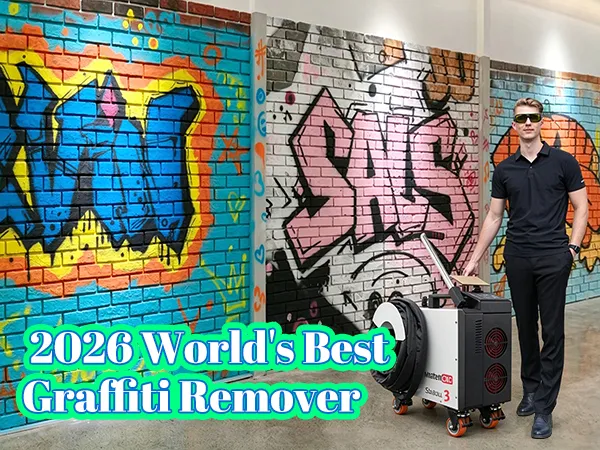
In this guide, we’ll compare the most common graffiti removal meth and use HANTENCNC’s real-world laser cleaning tests and performance data to explain why the SEAGULL3™ 500W Pulsed Laser Cleaner stands out for professional graffiti removal.
1. Traditional Graffiti Removers and Limitations
Graffiti on brick walls, concrete buildings, stone facades, and public facilities can be difficult to remove. Traditional graffiti removal methods, such as chemical solvents, pressure washing, and sandblasting, have been used for decades.
However, removing graffiti is more than removing unwanted paint. The main challenge is removing it without damaging the original surface, causing extra cleanup, or increasing long-term maintenance costs.
Now let’s look at the most common traditional graffiti removers and their limitations.
Chemical Sprays

Pressure Washing

Sandblasting

Laser Cleaning
For regular cleaning on tough concrete, pressure washing is often the most cost-effective choice. For delicate architectural surfaces, it may be worth considering a pulsed laser graffiti remover.
2. How Does a Laser Graffiti Remover Work?
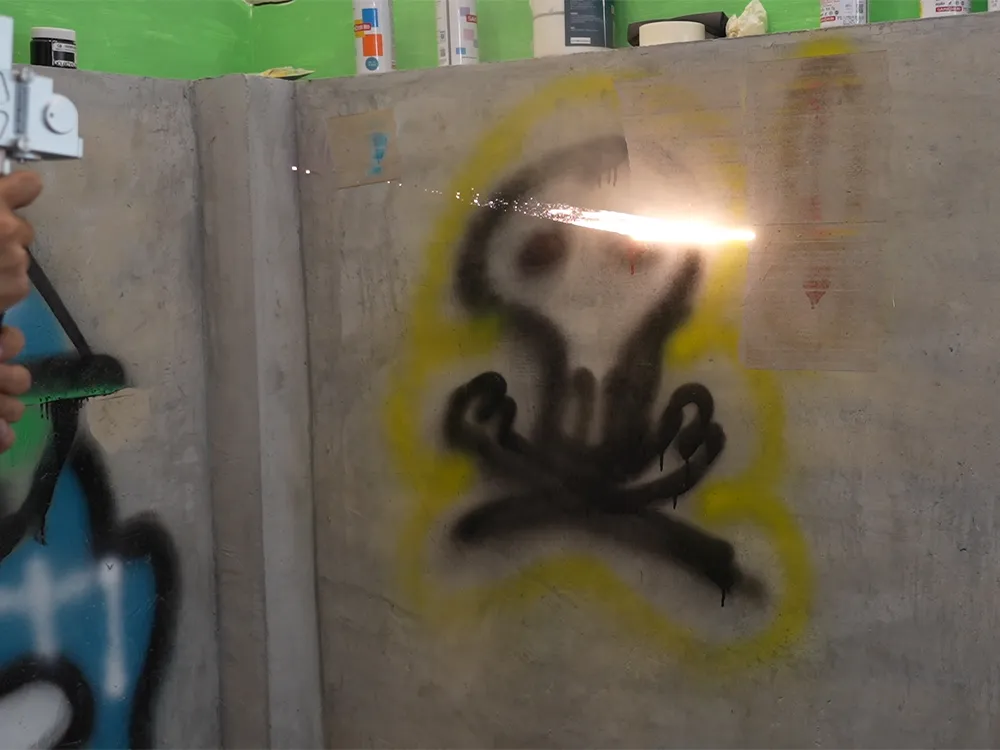
A laser graffiti remover uses concentrated laser energy to remove unwanted paint from a surface.
When the paint absorbs sufficient energy, it heats rapidly and can be removed through ablation. By adjusting laser parameters, trained operators can control how energy is delivered to the coating.


Unlike traditional cleaning methods, laser removal does not require water jets, chemical stripping agents, or abrasive particles.
Main advantages of laser graffiti remover
-
Controlled paint removal: Operators can adjust cleaning parameters for different coatings and substrates.
-
Non-contact cleaning: No abrasive media or high-pressure water strikes the surface.
-
Water-free operation: Useful where wastewater management is difficult.
-
Versatility: Suitable laser systems can also perform rust removal, paint stripping, and surface preparation.
Laser cleaning can be used on compatible brick walls, concrete, stone facades, metal shutters, and public infrastructure.
However, the process is not automatically damage-free. Dark and light paint colors absorb laser energy differently, while porous brick, soft stone, and previously painted surfaces may be sensitive to heat.
A small test patch is essential before cleaning an entire wall. Laser-generated fumes and particles also require appropriate extraction and filtration.
For additional applications, see HANTENCNC’s Laser Graffiti Removal Solution.
3. Pulsed vs. CW Laser Cleaners, Which is Best for Graffiti Removal?
Not all laser graffiti removers work the same way.
Continuous-wave (CW) lasers deliver a continuous beam of energy. They can remove coatings quickly, especially on durable surfaces, but prolonged heat input may cause scorching or discoloration.
Pulsed lasers deliver energy in short bursts. Their pulse settings offer greater control over energy delivery and heat accumulation, which can help preserve the original wall surface.
HANTENCNC Graffiti Removal Test: 300W Pulse vs. 2000W CW Laser Cleaner
HANTENCNC compared two laser cleaning machines on a graffiti-covered wall: SEAGULL2™ 300W Pulsed Laser Cleaner and 2000W Continuous Laser Cleaner.
Watch the actual comparison video as follows:

Comparison Result:
The 2000W CW laser removed the graffiti faster. However, it left yellowish marks on the cleaned wall, consistent with heat-related scorching.
The 300W pulsed laser worked more slowly but produced a cleaner finish with less visible damage to the underlying surface.
A pulsed laser graffiti remover is generally the better choice when cleaning quality and surface preservation matter. Although CW laser cleaning machines are typically more affordable, HANTENCNC’s test showed that the 300W pulsed laser delivered a cleaner finish with less visible wall damage than the 2000W CW laser.
For professional graffiti removal, protecting the original surface can be more important than saving money on equipment.
4. 2026 World's Best Laser Graffiti Remover - SEAGULL3™ 500W
The HANTENCNC SEAGULL3™ 500W Air-Cooled Pulsed Laser Cleaner combines efficient paint removal, controlled laser cleaning, and outdoor mobility, making it a practical choice for professional graffiti removal contractors.

Award-Winning SEAGULL3™
SEAGULL3™ received the 2025 EBRUN Global Innovative Potential Award, recognizing its innovation in laser cleaning technology.
With a 500W pulsed laser, air-cooled design, lightweight 1.5 kg cleaning head, and wheeled chassis, SEAGULL3 offers practical mobility for professional graffiti removal, including outdoor job sites with suitable safety and power arrangements.
HANTENCNC’s SEAGULL3™ Pulse Laser Cleaner Wins EBRUN Global Innovative Potential Award 2025
Faster Graffiti Removal with 500W Pulsed Power
Compared with the 300W SEAGULL2 used in HANTENCNC’s Pulse vs. CW test, the 500W SEAGULL3 offers higher cleaning capacity for certain paint thicknesses. According to HANTENCNC’s published data, its paint removal efficiency reaches 4–6 m²/h for 100–200 μm coatings, compared with 3–4 m²/h for a 300W pulsed laser.
Air-Cooled Design for Outdoor Cleaning
SEAGULL3 uses an air-cooled system, eliminating the need for an external water chiller. This simplifies equipment setup and makes the machine easier to transport between outdoor cleaning locations.
Portable and Easy to Move Between Job Sites
SEAGULL3 features a wheeled design and a convenient pulling handle, allowing operators to move the machine around buildings, along paved walkways, and between different graffiti-covered walls.
For contractors working across multiple locations in a single day, this mobility can reduce equipment handling and setup time.
Suitable for Different Outdoor Wall Surfaces
SEAGULL3 can be used to remove graffiti from compatible brick and concrete surfaces. HANTENCNC’s application demonstration includes red brick with a single paint layer, gray brick with multiple spray paint colors, and concrete with overlapping coatings.
Its adjustable laser settings help operators adapt the cleaning process to different materials while minimizing unnecessary surface damage.
Conclusion
The best graffiti remover depends on the surface, cleaning efficiency, and damage risk. While chemical removers and pressure washers work for many jobs, pulsed laser cleaning is better when preserving the original surface matters.
HANTENCNC’s 300W Pulse vs. 2000W CW test showed that faster cleaning does not always deliver better results. Even though CW laser cleaners are generally more affordable, pulsed lasers can offer better control and less visible surface damage.
For professional graffiti removal contractors, the HANTENCNC SEAGULL3™ 500W Air-Cooled Pulsed Laser Cleaner combines efficient paint removal, controlled cleaning, and easy mobility. Its wheeled design and air-cooled system make it especially practical for outdoor graffiti removal across multiple job sites.
Explore the HANTENCNC Laser Graffiti Removal Solution to find the right equipment for your project.
More Laser Graffiti Remover Blogs

HANTENCNC’s SEAGULL3™ Pulse Laser Cleaner Wins EBRUN Global Innovative Potential Award 2025
We are thrilled to announce that HANTENCNC’s product, SEAGULL3™ Pulse Laser Cleaning Machine, has been...
Dec

Does Laser Graffiti Removal Really Work?
If you’ve dealt with graffiti on a building, wall, or equipment, you know the struggle....
Oct

How Laser Technology Revolutionizes Graffiti Removal?
Graffiti is a beautiful artwork. It is vibrant, creative, and even inspiring. Yet, not all...
Sep