When you are preparing an object, proper surface preparation is crucial. Suppose you have an antique and you want to restore its appearance. Or, you might want to prepare components for assembly. All these tasks involve cleaning objects or components before the final operation. In this case, dry surface cleaning is one of the best ways to do so. Consequently, sandblasting is one of the most common dry blasting methods. However, it is messy and requires a large, controlled environment. That’s why you should look for alternatives to sandblasting.
This article will introduce you to the best alternatives to sandblasting for industrial surface preparation, with a special focus on laser cleaning. It will illustrate some of the key pain points of sandblasting and compare popular alternatives. Later, you will learn why laser cleaning takes the lead in overcoming these challenges to deliver precise, eco-friendly, and cost-effective surface treatment.
What is Sandblasting?
Sandblasting is one of the industrial finishing methods. This method is used to clean, remove, or etch the surface to give a finishing touch and make the product look appealing. The idea of sandblasting originated from manual scrubbing. It replaces the manual process by using high-pressure abrasive particles.
In sandblasting, a specialized machine uses an abrasive medium with an air compressor. They could include sand, steel grit, or glass beads. A nozzle fires these mixed particles at high speed, resulting in high friction on the part’s surface. This friction loosens and removes rust, dirt, and other contaminants.
Sandblasting has huge applications across different sectors. From shipbuilding, construction, and automotive work to restoration, people strongly prefer it for cleaning.

Sandblasting Pain Points: Why Alternatives are Needed?
Sandblasting is widely used for cleaning metals, wood, and other solid materials. However, it has several drawbacks. Therefore, it is not the best choice for every application. Sandblasting can affect worker safety and may damage delicate surfaces. Besides, it also increases operating costs. All these drawbacks push many industries to search for a better alternative to sandblasting.
Creates Large Amounts of Dust
Sandblasting produces large dust clouds during etching. This dust spreads all over the workspace and often settles on machine bodies. It creates a heavy problem while working. Workers often struggle to see things properly. Besides, dust comes out from the workshop and causes air pollution. Cleaning up this mess takes a lot of time when they get thick and go uncleaned for too long.
Health Risks to Workers
Health risks are among the major drawbacks of sandblasting. As you are aware, it produces a large amount of dust. You may face a severe disease if you do not prepare yourself properly before starting the process. If you become unaware or less conscious, long-term endurance can lead to silicosis, eye and skin irritations. Its sound can also damage your hearing system. Use all the protective gear necessary for your safety.
Can Damage the Surface
During sandblasting, excessive pressure when shooting can damage surface textures, especially on soft metals. It can also cause surface pits or scratches, resulting in material waste and extra cost. Sometimes, sandblasting removes more material than needed, weakening the material’s integrity.
High Operating Costs
Sandblasting also has high operating costs, driven by a few key factors. For example, changing the media repeatedly is quite expensive and adds an extra charge. Besides, cleaning up the mess it produces requires labor that demands high wages. The machine parts, like the compressor and nozzle, get damaged or wear out very quickly. Overall, these expenses make the process costly in the long term.
Difficult to Use on Precision Parts
Small, precision-sensitive parts can be ruined by sandblasting. The shooting particles do not strike the surfaces gently. It strips away the coating at high speed, leaving sharp edges. If you want to mask the delicate portions, it takes a lot of time and manual effort. Such inconvenience makes the process ineffective and less preferable for sensitive parts.
Environmental Concerns
Used abrasive materials later become toxic waste from blasting. Its abrasive media mix with lead paints or heavy metals, often based on requirements. These mixtures cannot be disposed of easily. Moreover, the dust from it also pollutes the surrounding environment and makes the air unhealthy to inhale. Applying water for cleaning also contaminates the soil. Overall, it can damage the nearby wildlife.
Alternatives to Sandblasting
From the discussion above, we can see that sandblasting has several limitations. These limitations are the main reasons why we look for alternatives to sandblasting. So far, several alternative methods have been developed.
| Alternative Method | Benefits | Applications |
|---|---|---|
| Laser Cleaning | Highly precise; no abrasive media; creates minimal wastes | Rust, paint, oil, grease removal |
| Dry Ice blasting | No secondary blasting media; leaves no residue; less cleaning time; non-abrasive | Machinery, electrical devices, auto parts, food processing equipment |
| Soda blasting | Gentle on surfaces; produces less surface damage; effective for paint and grease removal; relatively low dust. | Paint removal, automotive restoration, cleaning machinery, removing grease and coatings |
| Mechanical Cleaning | Simple and cost-effective; easy to control; requires basic tools; suitable for small areas. | Wire brushing, grinding, sanding, rust removal, paint removal, repair and maintenance |
| Power washing | Uses high-pressure water; removes dirt and loose coatings quickly; produces no abrasive dust; suitable for large areas | Building surfaces, concrete, vehicles, machinery, decks, walls and general outdoor cleaning |
| Chemical cleaning | Effectively removes rust, paint, grease, and oil; can reach complex shapes and difficult areas. | Metal cleaning, rust removal, degreasing, paint stripping and other industrial cleaning |
Laser Cleaning as the Best Alternative to Sandblasting
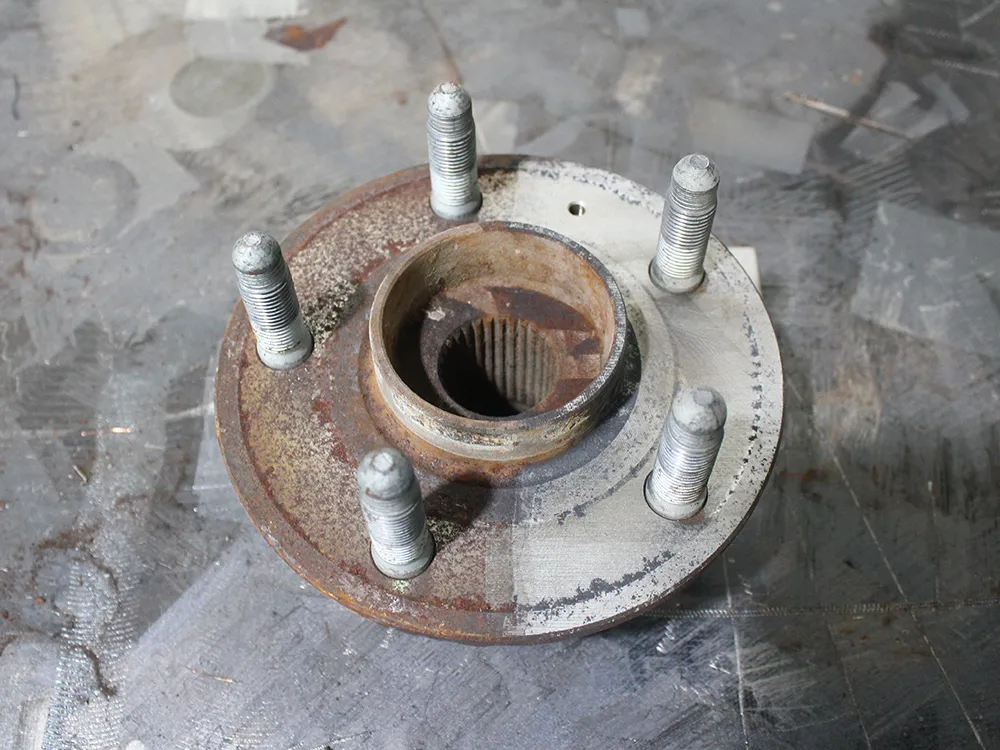
Laser cleaning is the easiest, cleanest, and fastest alternative to sandblasting. This technology uses a highly focused laser beam for the work. The focused laser beam produces rapid heating at the target area. The sudden heat melts or vaporizes the material above the base material. It doesn’t affect the base material, not even a single scratch. As a result, laser cleaning ensures efficient, clean surface preparation.
There are several reasons why you should choose laser cleaning as the best alternative to sandblasting. The following ten are some of the most crucial reasons.
Non-Contact Cleaning Process
Laser cleaning is one of the most popular and well-known methods worldwide. The non-contact approach makes it one of the chosen solutions. As you know, a laser operates using a high-energy beam of light. It does not make physical contact with the surface, which makes it a reliable option for cleaning.

No Damage to the Base Material
As mentioned earlier, its contactless working procedure makes it safe for base materials. The laser only targets the contaminant area and strikes it precisely. This way, it cleanly removes or vaporizes rust, paint, or other coatings. Besides, the base material reflects light efficiently and prevents scratches and wear and tear.
No Abrasive Media Required
Laser cleaning uses only light energy, not any consumables such as sand or grit. For this reason, this system is an effective alternative to sandblasting. You do not need to pay for extra materials here. Also, there is no messy media left to clean up afterward.
Environmentally Friendly
Since the laser system does not require other substances for cleaning, it does not produce any harmful chemicals or elements. There are no toxic contents. It produces only a tiny amount of dust, which is instantly absorbed by the vacuum system. Therefore, the surrounding ecosystem remains safe.
Lower Long-Term Operating Costs
While the machine requires a high initial investment, its running costs are very low. Unlike traditional methods, it’s an automated system, so you don’t need to invest extra in manual labor. The system also consumes a small amount of electricity and needs maintenance. So, the upfront cost remains significantly lower in the long run.
High Precision Cleaning
The focused beam can target tiny areas and remove contaminants. It can also handle complex shapes and tight corners easily. You can even adjust the laser to operate only on particular layers. This superior control also enables its use in highly detailed restoration work.
Easy Automation
According to the requirements, you can easily mount the laser head to robotic arms. Its CNC advantage enables precise control of speed and head movements. As a result, it becomes useful for factories to clean parts on high-speed assembly lines. Thus, it removes human errors.
Safer and Cleaner Workplace
This method eliminates contamination or dust clouding, as seen with sandblasting. No toxic chemicals are produced during laser operation. You do not need heavy respirators to breathe safely. As a result, the workspace remains clean and safe during operation. This is why it is one of the safest alternatives to sandblasting.
Suitable for Many Materials
The laser works on a wide variety of materials. You can use it on metal surfaces such as steel, aluminum, copper, and others. It can also handle delicate plastics or other composite materials. This flexibility is also a reason it has become one of the most popular sandblasting alternatives.
Ideal for Modern Manufacturing
Modern manufacturing needs modern solutions. Laser easily fits in smart-tech factories. It is precise and fast, leaving nearly zero mess. Thus, companies can easily meet green energy standards.
HantenCNC Laser Cleaning Machines
HantenCNC is a professional Laser machine manufacturer offering a range of machines for various sectors.
The DOLPHIN™ 1000W-2000W Pulse Laser Cleaner is a high-end machine. It offers cleaning for a wide range of metals, wood, plastics, and paper boxes. It uses pulse energy that does not affect the base material. With it, you can remove paint down to 50–100 μm. Cleaning efficiency is 10–15 m²/h, nearly twice that of a 500W machine.
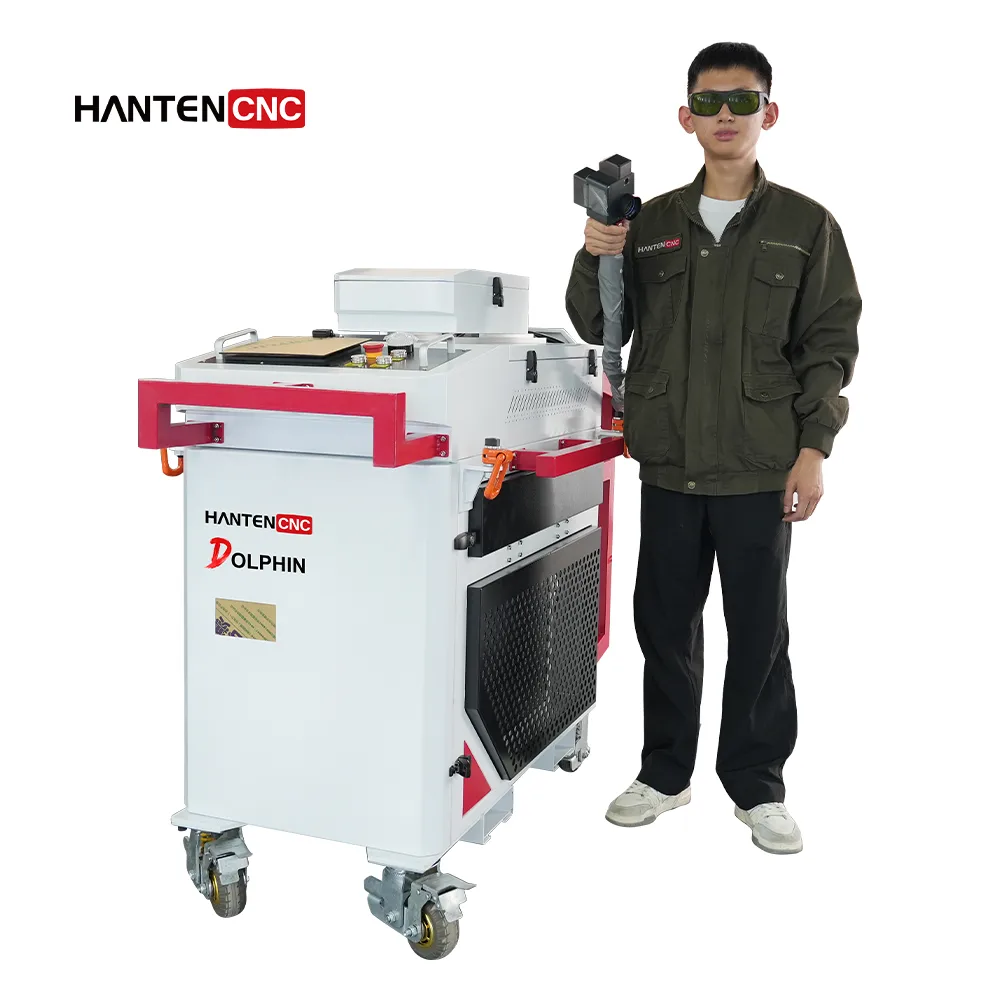
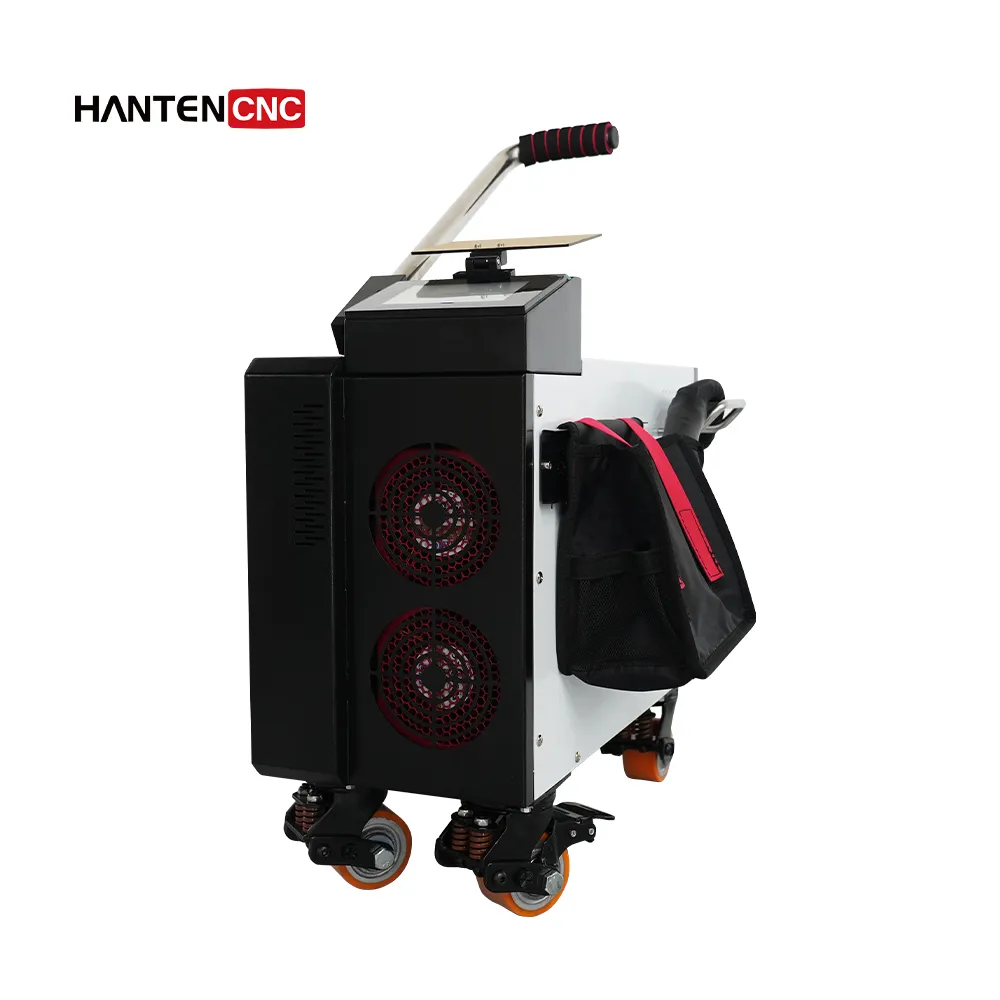
SEAGULL3™ 500W Air-cooled Handheld Laser Rust Removal is an advanced HantenCNC machine. It removes paint, rust, and oils without damaging the surface. This system can easily clean up to 15 m2 of 20 μm-thick paint or rust. You can reliably use it for both large-area work and precision tasks. Its material flexibility includes the ability to handle various materials, such as metals, wood, and stone.
Conclusions
Sandblasting uses high-speed abrasive particles, such as sand, to remove material from a surface. Thus, the name is sandblasting, blasting sand for cleaning. This method is widely used to remove rust, paint, and other surface contaminants. Although it is effective, it creates dirt, dust, and waste. The cleaner must wear safety PPE; otherwise, it may pose various health concerns. Besides, sandblasting also increases operating costs.
Considering these limitations, laser cleaning is the best alternative to sandblasting. It is fast, precise, non-contact, and environmentally friendly. It also delivers excellent cleaning results.
HantenCNC is a leading manufacturer of various laser cleaning machines. It has laser cleaners for starting from workshops to large industries. Besides, there are various combo packs, such as cutting, welding, and cleaning. Based on your project needs, you can customize your laser cleaner. For more information, feel free to contact our customer support team.